We leave places better.
Responsible tourism at Witsieshoek is not a policy document or a set of aspirations. It is the way the Lodge has been run, day by day, since 2011. This page describes what we actually do.
Honouring the Batlokoa Homeland
Witsieshoek Mountain Lodge sits adjacent to the UNESCO World Heritage Site in the Maloti Drakensberg Transfrontier Conservation Area. Hikers continuing from the Amphitheatre into Royal Natal National Park traverse the UNESCO site. The land belongs to the Batlokoa community. The mountain is also part of a wider protected landscape used and loved by hikers, researchers, guides and neighbouring communities. Our obligation is to hold both truths carefully.
Transfrontier Parks Destinations, who manage the Lodge on behalf of the Batlokoa, operate from a single principle: responsible tourism is not about leaving no trace. It is about leaving things better. Better for the people who live here, better for the land, and better for the guests who come.
What follows is a plain account of how we do that.
Economic Responsibility
The single most significant thing Witsieshoek does for its community is run a commercially sound operation.
96% of Lodge staff are employed from the local area. Each salary supports an average of seven people. The salary bill runs to millions of rands annually – money that circulates in a rural economy that has few other sources of formal employment.
Beyond employment, the Lodge buys locally wherever possible – from local traders, local suppliers, and local entrepreneurs – even when national supply chains would be cheaper. The margin that the Lodge foregoes is the margin that goes into the local economy instead.
The Lodge makes rental and profit share payments to the aBatlokoa Foundation NPC, the community entity that owns the Lodge’s assets and decides independently how those funds are used for community development. This is not charity. It is the commercial structure that was designed from the beginning to make community ownership real rather than nominal.
Since reopening in 2011, Witsieshoek has generated a Regional Economic Benefit of over R93.9 million, tracked annually against consistent metrics. 62.5% of that value came from local procurement policies and practices. This data is reported to all stakeholders at three Public-Private-Community Advisory Committee meetings held each year.
Employment and Skills
Local employment is prioritised at every level of the organisation. This is not a diversity target – it is a founding principle, and it is measured.
The Lodge offers ongoing internships for students completing tourism qualifications through TVET colleges and universities, providing the practical in-service training hours they need to graduate. Several current staff members came through this programme.
The Lodge also participates in national government EPWP Tourism Monitor programmes, providing work opportunities for previously unemployed individuals with meaningful management oversight – ensuring that public investment in employment creates real skills, not just hours.
When the Lodge was refurbished after 2010, the commitment to local procurement extended to skills development: seamstresses, cabinet makers, potters and carpet weavers were supported to develop the capability to meet commercial standards. Some of those businesses have since expanded into markets beyond Witsieshoek. The Lodge helped open those doors.
Energy
Witsieshoek has installed a solar energy system with battery storage. The Lodge operates on a solar-first basis: solar and batteries supply power as the primary source, the national grid provides backup, and a generator is the last resort when both are unavailable.
In summer, and on clear days at 2,200 metres, the system runs the Lodge entirely off-grid. In winter, or during extended overcast periods, grid backup is needed. This is an honest account of where the system currently stands. The system does not make Witsieshoek impact-free, but it has changed how the lodge operates.
Environmental Stewardship
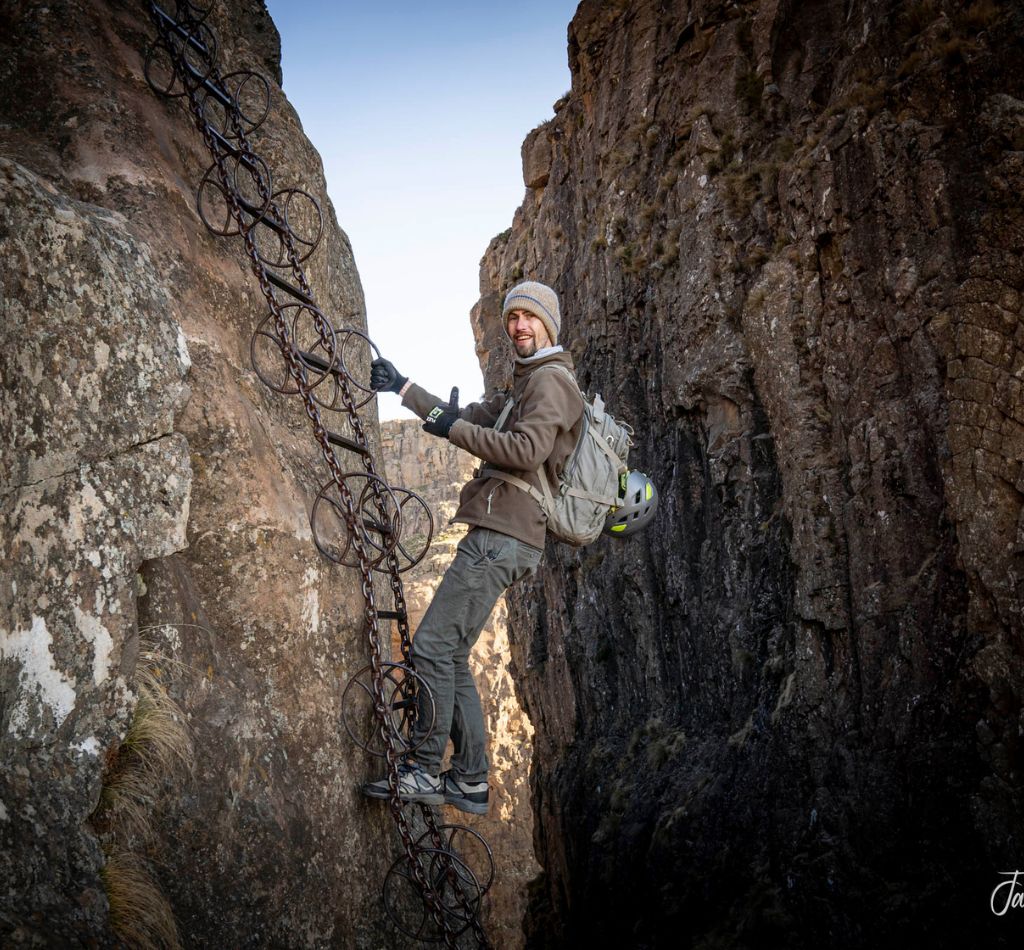
The Witsieshoek property sits within a functioning alpine ecosystem. The grasslands, the streams, the rock faces and the plateau above the Chain Ladders are protected not because of a policy, but because the Batlokoa community’s long-term interests require that they remain intact.
Witsieshoek hosts the Afromontane Research Unit of the University of the Free State’s QwaQwa campus, which operates the highest research facility in Africa at 3,069 metres on the Namahadi plateau. Long-term studies are underway on alpine vegetation change, climate data collection across multiple weather stations on the property, and grassland biodiversity. Early research findings have identified colonies of dung beetles that are no longer commonly found in surrounding disturbed farmland, making the Witsieshoek property an important site for ongoing grassland biodiversity research.
The grasslands, the streams, the rock faces and the plateau above the Chain Ladders are protected not because of a policy, but because the Batlokoa community’s long-term interests require that they remain intact.
The primary activity at Witsieshoek, by design and by the nature of the terrain, is hiking. The mountain trail network draws visitors who come specifically to walk, climb and experience the landscape on foot.
Not all visitors treat the trails with the care the mountain deserves. Witsieshoek runs Enviro Crews – teams dedicated to cleaning the key trails from the Lodge all the way to Tugela Falls – to prevent the build-up of waste and protect the mountain environment that makes the hike worth doing.
Governance and Transparency
The structure of ownership and management at Witsieshoek is clear and documented, with formal records held by the relevant parties. Public reporting focuses on the operating model, economic benefit, local procurement, employment and the advisory committee process.
Witsieshoek Mountain Lodge (Pty) Ltd manages the commercial operation. The aBatlokoa Foundation NPC holds the assets and determines how community funds are deployed. These are separate entities with separate roles. The community retains ownership and control of its asset. The operator is accountable to the community through the formal Advisory Committee structure, which meets three times a year with multi-stakeholder participation including government representatives, community leadership, and the commercial operator.
Annual financial reports track revenue, profitability, local employment, local procurement, and payments to the aBatlokoa Foundation NPC. This data has been published consistently since 2011 and is presented through the Advisory Committee process.
In 2022, this track record was recognised with the Global Gold Award at the World Travel Market Responsible Tourism Awards in the category of Local Economic Impact – the highest recognition in responsible tourism globally.
Social Responsibility
Witsieshoek does not stage cultural performances for guests. The Batlokoa are a living community, not a heritage exhibit. Guests who are interested may, when appropriate, be directed to local church services in the village, where visitors are welcomed as guests rather than spectators. The team may also recommend local traders and craftspeople in Tsheseng. These are invitations, not products.
In recent months, Lodge staff have formed their own choir and occasionally sing in the lounge in the evenings, wearing traditional dress – a staff initiative, warmly received by guests. It is their culture, offered on their own terms, which is exactly as it should be.
The Lodge’s founding operator, TFPD, operates from the position that responsible tourism does not try to freeze communities in an imagined past. The aim is engagement with people as they are – with the culture they practise today, on their own terms.
Fair Trade Tourism certified. 4-star graded by the Tourism Grading Council of South Africa.